What the echo is supposed to copy
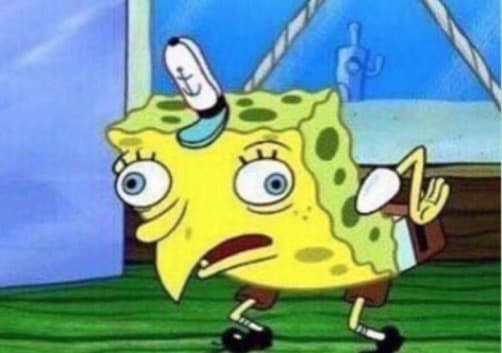
Mocking SpongeBob is the 2017 still of SpongeBob hunched like a chicken, from the episode where he mimics one. People mapped that posture onto sarcasm: take someone’s earnest sentence and say it back in alternating caps. Two boxes. The top can hold the original line in normal case, and name who said it if the words alone are not enough. The bottom is the same words, mocked. The hunch is the audio. Straight sentence case on that body looks like a typo.
Keep the wording almost identical, and let the hunch carry the sarcasm. “We should circle back” over the same sentence again is the whole post. The canvas draws every caption in capitals, so mixed-case mockery will not survive the download. A clever new point in the second box is a rebuttal, and Batman Slapping Robin is the panel where a bad idea gets shut down with a different sentence. This pose introduces nothing. It makes the original speaker hear themselves repeated. If you only have room for one string, make it the echo, and let the hunch imply the source.
The body has to stay visible. A banner across the hunch removes the way people hear the voice. Walls of alternating caps get hard to read, so one short echo is enough. The template is for roasting a take. It is the wrong picture for a speech difference, an accent, or a disability. Teachers using it on a student get the cruelty of the pose without the cartoon as a buffer. A work chat can use it on an email’s own jargon. It should not be aimed at how a person talks.
Top box, the original sentence: “we should circle back.” Bottom box, the same sentence again. The hunch is the sarcastic voice. A clever new point in the second box is a rebuttal, and that is a different panel. This pose introduces nothing. It makes the original speaker hear themselves repeated. If you only have room for one string, make it the echo and let the posture imply the source.
The canvas will not preserve alternating capitals. Every caption is uppercased before it is drawn, so a mixed-case mock becomes the same shape as the original line. That is why the hunch has to stay visible. A banner across the body removes the way people hear the voice. The template roasts a take. It is the wrong picture for a speech difference, an accent, or a disability. A work chat can use it on an email’s own jargon. It should not be aimed at how a person talks.
You download a JPEG at quality 0.92. The letters are white with a black stroke, and Impact is the font that starts selected. Because both lines become capitals, keep them short and nearly identical so the echo is obvious without mixed case. Open the file and confirm the chicken pose is still the loudest thing in the frame. The download is a still.
Put the original sentence in the top box and the same sentence in the bottom box. Do not invent a better point underneath. The hunch is the mockery. Alternating capitals will not survive, because the canvas uppercases every caption before it draws it. Plan for that. If both lines are short and identical, the echo is still obvious once the posture is visible. If you cover the hunch, both lines look like a duplicated caption and the voice disappears. This pose roasts a take, a piece of jargon, an email’s own words. It is the wrong tool for an accent, a speech difference, or a disability, and it is the wrong tool for a teacher aiming it at a student. A new sentence in the second box is a rebuttal and wants a different panel. Export, read the two lines, and confirm they match. Then look at the body. The chicken pose has to be louder than the type.
Written by Safaat Rahman Siham, Founder & Developer at Convertify4u. Contact us.